For years, enterprises relied on army-sized call centers to handle everything from loan sales and support queries to cart recovery. Yet, even with thousands of human representatives on the floor, high-value leads routinely slipped through the cracks due to rigid queues, agent burnout, and inconsistent training.
While conventional wisdom suggested hiring more supervisors or running longer training sessions, the founders of Arrowhead identified the root issue: human-led voice operations simply cannot scale efficiently at enterprise volume.
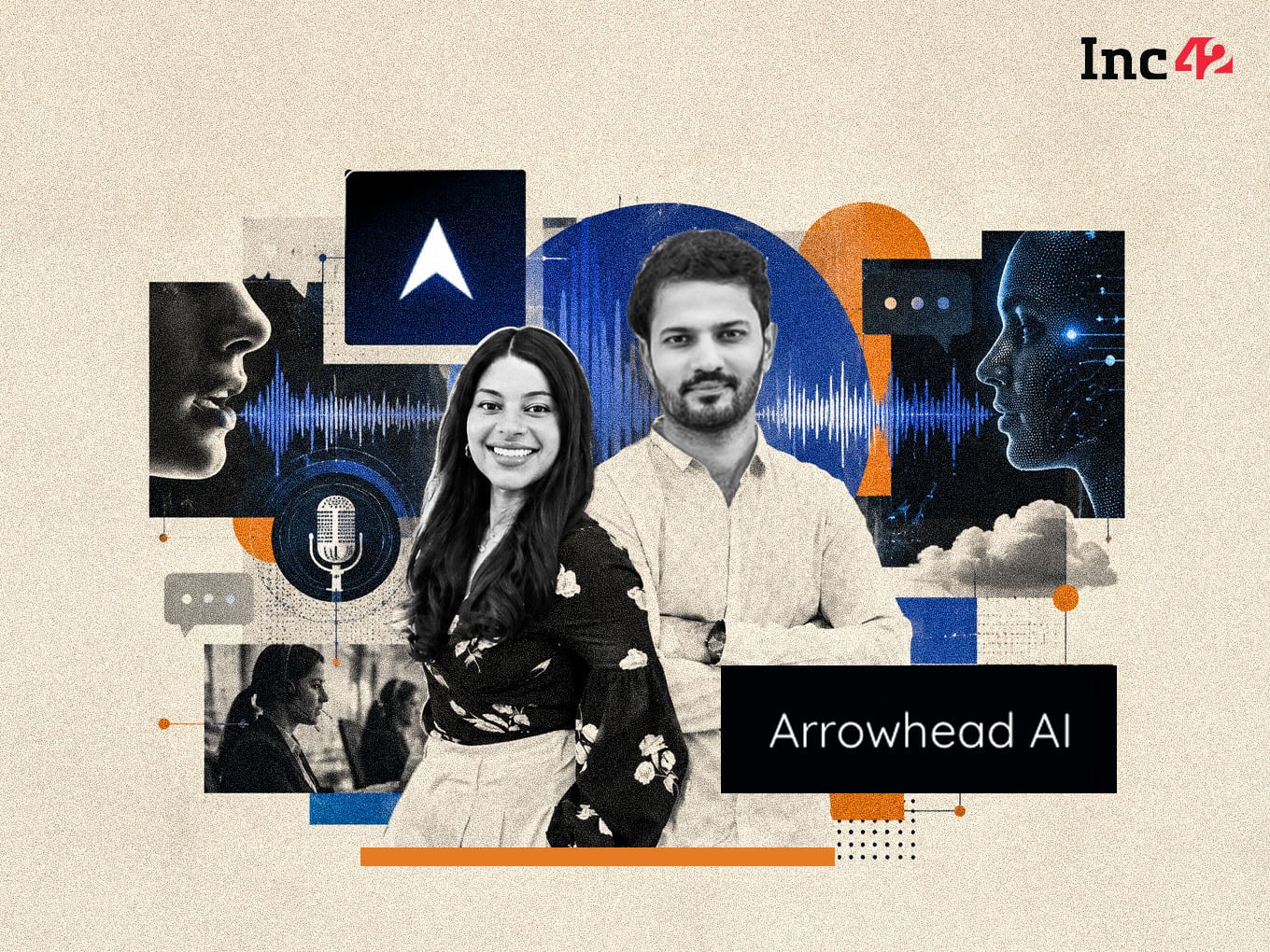
Founded in 2022 by Devyani Gupta and Vengadanathan Srinivasan, the startup shifted its focus toward building autonomous, voice-first AI agents tailored for large enterprises. Today, the company powers autonomous voice interactions across leading banks, non-banking financial companies (NBFCs), e-commerce platforms, and healthcare providers.
Having closed a $3 million seed round led by Stellaris Venture Partners in January 2026, the company now works with over 50 enterprise clients in the Banking, Financial Services, and Insurance (BFSI) and healthcare sectors—including Tata 1mg, Bank of Baroda Cards, IndiaMART, Aditya Birla Capital, Paytm, Turtlemint, Kissht, and InsuranceDekho.
The Strategic Pivot: From Call Analysis to Full Automation
The startup did not begin as an automated voice platform. Its initial product was a conversation intelligence tool designed to analyze recorded human sales calls for mis-selling and compliance violations. Early clients, such as edtech platform upGrad, used the platform to identify script gaps that caused refund requests.
However, as generative AI accelerated through 2023 and 2024, the founders realized that analyzing human sales calls meant optimizing a medium that was rapidly becoming obsolete.
Recognizing that traditional call center queues were nearing their end, the company pivoted in late 2024 to build a dedicated, voice-first platform. Rather than competing in the crowded text chatbot market, the team focused on automating complete voice workflows for regulated industries.
Interestingly, many enterprise clients that originally purchased the call analytics software eventually upgraded to the autonomous voice agents—replacing human call queues entirely.
Rebuilding the Tech Stack from the Ground Up
To deliver real-time, human-like voice interactions, off-the-shelf APIs proved insufficient. The team set out to own and optimize every layer of its technology stack:
- In-House Small Language Models (SLMs): Fine-tuned on top of open-source foundational models like Gemma and Qwen, these specialized SLMs prioritize low latency and conversational coherence over raw parameter scale.
- Proprietary Text-to-Speech (TTS): Trained on thousands of hours of custom audio recorded by professional voice actors, the system captures natural human nuances—including empathy, hesitation, filler words, and regional speech cadence across multiple Indian languages (Hindi, Tamil, Telugu, Kannada, and Malayalam).
- Sub-500ms Response Latency: Optimized inference infrastructure keeps latency under 500 milliseconds, eliminating awkward pauses and enabling fluid, natural interruption handling during live calls.
- On-Premise & Single-Tenant Security: Built specifically for regulated sectors, the architecture emphasizes data residency, privacy, and single-tenant deployments to ensure sensitive customer data stays within local borders.
- Voice Orchestration Engines: Enables real-time integration with internal enterprise APIs during live calls for document verification, credit checks, and inventory updates.
The company reports that in over 90% of deployments, end-users cannot distinguish its voice agents from human representatives unless explicitly informed.
3 Core Enterprise Workflows Drive Adoption
While expanding into e-commerce and healthcare, roughly 80% of company revenue currently stems from financial services. The voice AI platform is primarily deployed across three core operational workflows:
Enterprise Voice AI Workflows
| Workflow PNG | Key Capabilities & Actions PNG |
| 1. Outbound Loan Sales | Document Collection & Real-Time OCR |
| 2. Inbound Customer Care | Intent Detection & Policy Queries |
| 3. Cart Recovery & Sales | Discount Application & Instant Pay |
- Outbound Loan Sales: Agents go beyond basic lead qualification, guiding applicants through document intake, OCR verification, and direct submission to underwriting teams during a single live conversation.
- Inbound Customer Support: Agents classify incoming customer intent, query enterprise databases, resolve complex policy questions, and retrieve account records without human intervention.
- Cart Abandonment Recovery: In e-commerce setups, agents reach out immediately after a user leaves a checkout funnel. The voice agent can modify cart items, apply discount codes, update delivery details, and process transactions directly during the call. In its deployment with healthcare platform Tata 1mg, cart recovery conversions improved by roughly 15% compared to human-led outreach.
Monetization and Industry Hurdles
The company operates a hybrid monetization model, combining usage-based per-minute pricing (which accounts for the majority of revenue at 25% to 30% gross margins) with outcome-linked performance incentives. Aligning pricing with business results helps cushion against declining AI inference costs over time.
Despite early traction, the voice AI sector remains highly competitive, with well-funded players like Observe.AI, Bolna, and Gnani.ai vying for market share. Managing unit economics—particularly the compute costs associated with running real-time LLM inference alongside high-quality TTS—remains an ongoing operational focus for early-stage platforms.
Final Thoughts
Replacing legacy call queues is only the first phase. The broader shift in enterprise software lies in transitioning voice platforms from basic conversational interfaces to fully autonomous agents capable of executing end-to-end operational tasks. As voice infrastructure becomes commoditized, maintaining edge-case reliability, deep API orchestration, and low-latency performance will separate the market leaders from the rest.