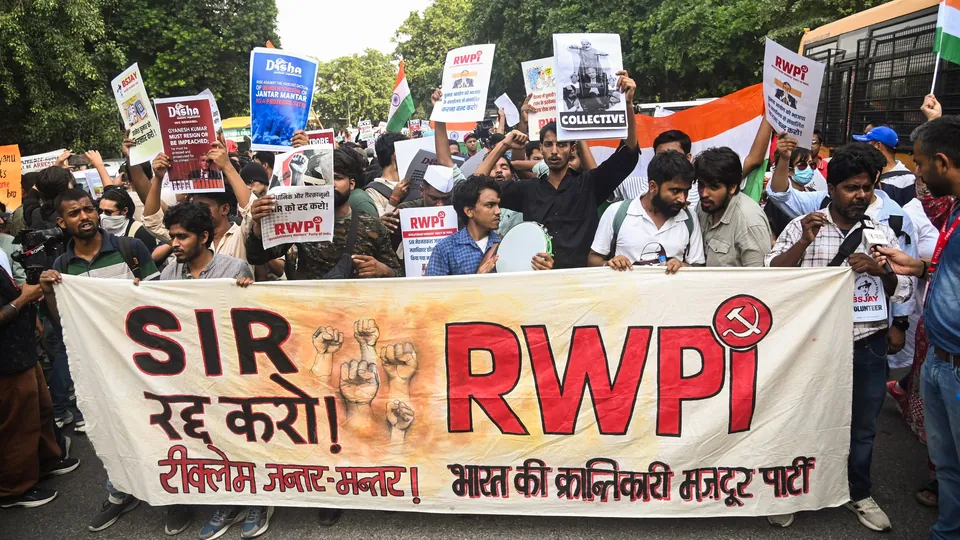
The opposition has alleged that the software used to flag errors and irregularities in the electoral roll during the Special Intensive Revision (SIR) process lacks transparency—a claim that has cast doubt on the Election Commission (EC) and undermined public trust in the entire process.
On Sunday, Congress General Secretary Jairam Ramesh accused the Election Commission of refusing to disclose details about the ECINET software, claiming this “exposes the truth about large-scale, centralized electoral manipulation.” Party leader Pawan Khera lashed out at Chief Election Commissioner Gyanesh Kumar for “obstructing transparency in the electoral process.”
Trinamool Congress (TMC) leader and Rajya Sabha MP Menaka Guruswamy questioned what exactly the election body is “hiding.”
The three opposition leaders made these remarks while referring to a report in the Hindustan Times. The report stated that the Election Commission had refused to disclose the name and version of the software it used to identify errors and anomalies during the verification of electoral rolls. The Election Commission claimed that this information pertains to “commercial secrets, business secrets, and intellectual property,” and is therefore exempt from disclosure under the Right to Information Act.
As of the time of publication, neither the Election Commission nor the Bharatiya Janata Party (BJP) had provided an immediate response; however, both have previously denied any wrongdoing in the process of revising the electoral rolls.
“The Election Commission of India continues to withhold information regarding the controversial ‘ECINET’ software—the core component of the disastrous Voter Registration System (SIR)—which has been used to centrally manipulate electoral rolls. Today, a major national daily revealed that the Election Commission, in response to a Right to Information (RTI) request, refused to provide details about the software used in the SIR. Sharing a report from the Hindustan Times on X, Ramesh stated: ‘The Election Commission of India has offered flimsy excuses to avoid disclosing the name of the software used in the SIR, and has also refused to confirm whether artificial intelligence is being employed or what security measures are in place.'”
This Congress Party leader stated, “The lack of transparency in the ECINET software, along with the use of artificial intelligence, has undermined the credibility of the entire electoral process in the eyes of the public.” He added, “The Election Commission has repeatedly refused to provide this information, as doing so would reveal the truth about large-scale, centralized election manipulation.”
He also questioned why the Election Commission failed to publicly disclose that the software was developed by Tata Consultancy Services (TCS)—a fact he claims to have learned from the company’s own disclosures. “Given that artificial intelligence has clearly been used for voter registration and the revision of electoral rolls, why has the Election Commission repeatedly denied the use of AI?”
“The Election Commission’s ECINET software and its IT division have been the focus of repeated objections raised by Election Commissioners Sukhbir Singh Sandhu and Vivek Joshi. These complaints even reached the Department of Personnel and Training (DoPT), which operates directly under the Prime Minister. It is public knowledge that large-scale manipulation has taken place. Gyanesh Kumar must step down, and the Special Investigation Reporter (SIR) must be suspended immediately,” he said.
Khehra also lashed out at Chief Election Commissioner Kumar over the matter. On social media, he questioned: “Why is Gyanesh Kumar Gupta obstructing the transparency of the election process—as if it were evidence at a crime scene, and he himself were the perpetrator?”
He alleged that the Election Commission of India has subverted democracy, adding that the truth can no longer be concealed.
Guruswamy also lashed out at the Election Commission over the report. “This is absolutely absurd! What exactly is the Election Commission hiding???” she wrote on X.
On Sunday, the Hindustan Times reported that the Election Commission also stated it had “not developed or procured any new software for voter registration,” and that Electoral Registration Officers (EROs) decide whether to include or exclude individuals from the electoral roll “based on facts and records.”
This response, dated October 16, was issued in reply to a Right to Information (RTI) application filed by MA Mujeeb Ayyub, a social activist based in Karimnagar, Telangana.
Ayyub sought information regarding the names and versions of any software, applications, or artificial intelligence (AI) platforms used to detect errors or inconsistencies in voter data; whether such systems automatically flag records for verification, correction, or deletion, and the subsequent workflows involved; whether artificial intelligence, machine learning, predictive analytics, or automated decision-support tools are employed at any stage; the safeguards in place to prevent false positives and the erroneous flagging of legitimate voters; and the authority responsible for reviewing or approving flagged anomalies before any action is taken regarding voter records.
Regarding Ayyub’s first question, the Election Commission of India cited Section 8(1)(d) of the Right to Information Act, which provides an exemption for information—such as commercial confidences, trade secrets, or intellectual property—the disclosure of which would harm the competitive position of a third party.
As for the inquiry concerning the use of automated tagging, artificial intelligence, or machine learning—as well as the safeguards in place to prevent erroneous tagging—the Commission stated that the information sought constitutes a “clarification” and does not fall within the definition of “information” as set forth in Section 2(f) of the Act.